Spam vs Phishing Explained: Similarities, Differences, and Risks
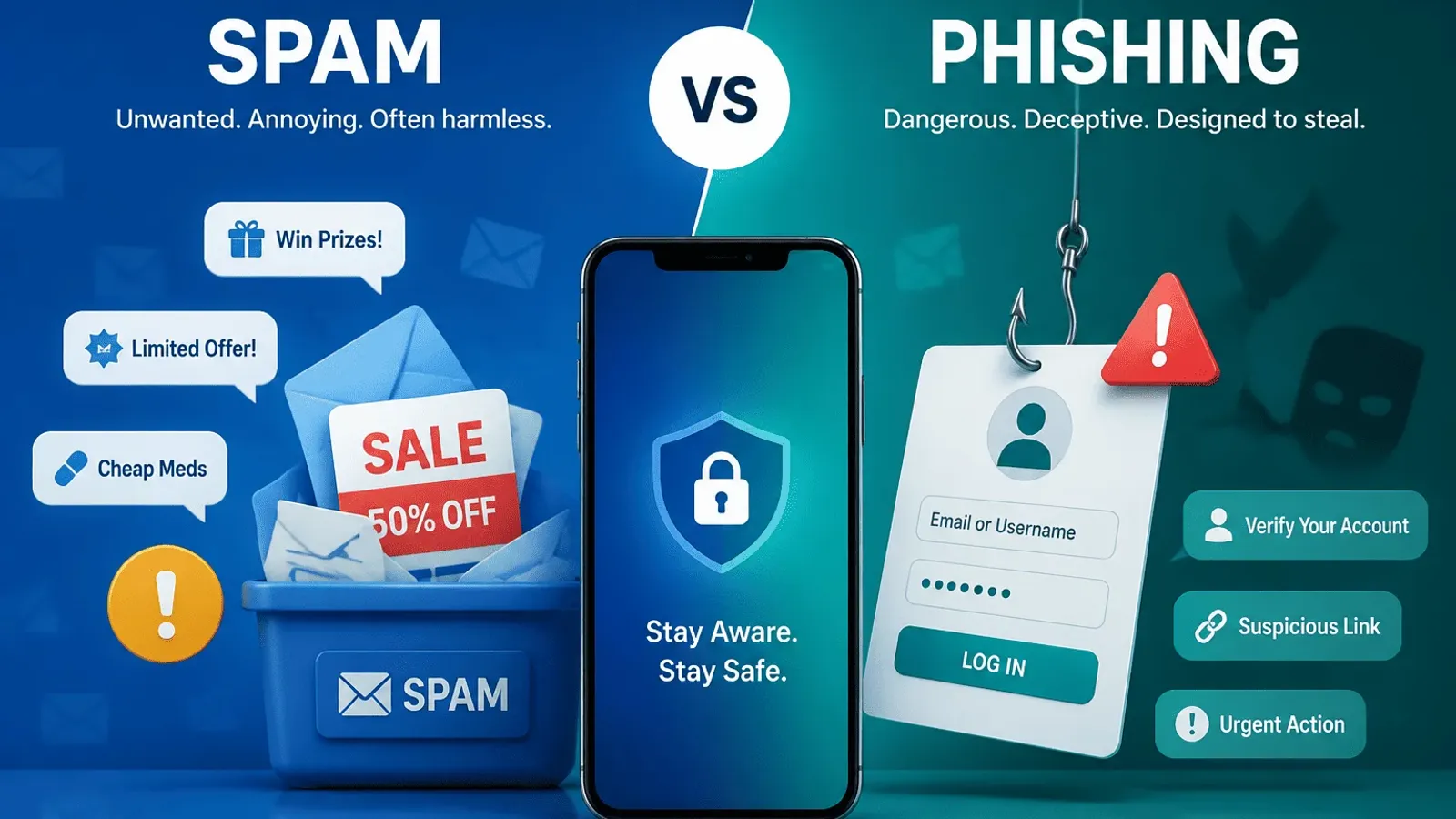
According to the National Do Not Call Registry Data Book, Federal Trade Commission, Fiscal Year 2025, unwanted call complaints remain roughly 48% lower than in FY 2021, even as scam calls continue to slip past the registry entirely. That gap points to a mix-up a lot of people make: treating spam and phishing as the same problem.
Spam and phishing often arrive looking almost identical: an unexpected text, a strange call, an email you did not sign up for. But they are not the same thing, and knowing the difference between spam and phishing changes how seriously you should treat a given message. Plenty of people search for what the difference is between spam and phishing only after clicking on something they later regret.
Spam is mainly about unwanted communication. Phishing is designed to trick you into revealing information, giving access, or sending money. When you weigh phishing vs spam side by side, the gap in intent is what should drive how cautious you actually need to be. This guide breaks down what the difference is between spam and phishing, where the two overlap, and how one can quietly turn into the other.

What Is Spam?
Spam is unwanted messages or calls sent in bulk, usually for advertising, promotions, or low-quality offers. It is annoying and disruptive, but not every spam message is designed to steal information.
Common examples include promotional emails you never subscribed to, robocalls about extended car warranties, marketing texts from old sign-up forms, unwanted newsletters, and repeated sales messages from the same company. Most spam and phishing confusion starts right here, since both can show up as a text from an unknown number.
Common Types of Spam Communication
Spam generally falls into a few recognizable categories, each with its own typical format.
- Marketing spam - Unwanted product offers, discount promotions, subscription messages
- Call spam - Robocalls, automated sales calls, repeated calls from unknown numbers
- Message spam - Bulk SMS campaigns, promotional texts, fake surveys
Good to Know: Spam is regulated differently than phishing. Legitimate marketing spam usually has to include an opt-out option under laws like the CAN-SPAM Act, while phishing has no legal option to unsubscribe from, because it was never legal in the first place.

What Is Phishing?
Phishing is a type of scam where attackers impersonate a trusted source to steal sensitive information or gain access to an account. The CISA joint phishing guidance describes phishing as a leading way attackers gain their first foothold into a network or account, which is why it carries far more risk than ordinary spam.
Phishing attempts usually target passwords, banking information, one-time verification codes, personal details, or direct account access. Unlike spam, phishing is built around deception rather than volume.
Phishing can happen through email, text messages (a tactic called smishing), phone calls (a tactic called vishing), or social media messages. The channel changes, but the underlying goal, getting you to hand over something valuable, stays the same. This is a key part of phishing vs spam: spam tends to stick to whichever channel is cheapest to blast out in bulk, while phishing follows wherever you are most likely to respond.
Common Types of Phishing Attacks
Phishing attempts tend to follow a handful of recurring scripts, no matter which channel they use.
- Fake bank and account security alerts claiming your account is locked or needs urgent verification.
- Delivery and package scams asking you to pay a small fee or "confirm" an address to release a package.
- Fake customer support messages posing as help desks for services you actually use, sometimes reinforced by voice cloning technology that makes a caller sound like someone you already trust.
- Workplace impersonation scams where a "manager" requests gift cards or a wire transfer.
- Government or legal threat scams claiming unpaid taxes, fines, or pending legal action.
- Account verification scams asking you to "confirm" login details through a fake page.
Spam vs Phishing: What Is the Difference?
The clearest way to separate spam vs phishing is to look at intent, risk, tactics, and what the sender actually wants from you. The table below summarizes the core differences before the details.

Main Goal
Spam usually aims to advertise a product, promote a service, or generate engagement, even when it is unwanted. Phishing aims to steal information, money, or account access, which makes the intent behind each message fundamentally different.
Level of Risk
Spam often creates inconvenience and wasted time, but rarely causes direct financial harm on its own. Phishing vs spam looks very different here, since phishing can lead to identity theft, financial loss, hacked accounts, or exposed personal data.
How They Try to Influence Users
Spam relies on volume and repetition, betting that enough messages will eventually generate a few clicks or sales. Phishing instead uses urgency, fear, trust, authority, or curiosity to manipulate a single decision in a single moment.
What the Attacker Wants From You
Spam usually wants a purchase, a subscription, or a website visit, all of which are annoying but ultimately low stakes. Phishing wants your login credentials, payment details, verification codes, or other personal information that can be used or sold.
Similarities Between Spam and Phishing
Despite their different goals, spam and phishing share enough surface-level traits to explain the confusion between them.
- Both can arrive unexpectedly, without any prior relationship with the sender.
- Both may come from unknown senders, unfamiliar numbers, or spoofed addresses.
- Both can use fake names, logos, and brand formatting to appear legitimate.
- Both may show up through email, text messages, or phone calls.
- Both waste time and create some level of digital risk.
- Both often rely on automation to reach large numbers of people at once.
How Spam Can Turn Into Phishing
Some spam is genuinely harmless marketing. Other messages that look like ordinary spam are actually the first step of a scam.
A spam text with a fake delivery link, a promotional email that leads to a fake login page, or a robocall asking you to "verify" account information can all look like routine spam at first glance. This pattern shows up often in robocalls from unfamiliar or international numbers, where a call that looks like routine spam turns out to be a scripted scam attempt. The difference is intention: harmless spam wants a click or a sale, while disguised phishing wants your credentials or your money.
Quick Tip: If a spam-looking message ever asks you to log in, confirm a password, or enter payment details to "claim" something, treat it as phishing rather than spam, regardless of how ordinary the rest of the message looks.
Where This Distinction Gets Risky in Everyday Life
Knowing the theoretical difference between spam and phishing is one thing. Applying it correctly in the middle of a busy day is another, and that gap is where real risk shows up.
- Treating all unknown numbers the same is a common mistake. Dismissing every unfamiliar call as harmless spam can mean missing an active phishing attempt disguised the same way.
- Phishing increasingly mimics spam on purpose. Attackers know people are quick to dismiss anything that looks like marketing, so some phishing is deliberately styled to blend in.
- Reporting the wrong category slows down protection for everyone. Marking a phishing attempt as simple spam means it may not get flagged as a scam, which affects detection for other users too.
- Caller ID alone cannot make the call for you. A number's reputation is a strong signal, but confirming the actual content of a message still matters.
Tools built for this distinction help close that gap. Sync.me's caller ID and spam protection flags known spam and scam numbers before you answer.
If you do end up engaging with a scam caller, understanding what actually happens once you stay on the line makes it easier to limit the damage.
Same Inbox, Different Intent: What to Remember
Spam and phishing overlap in how they arrive, but they differ sharply in what they want from you. Spam is mainly unwanted communication, while phishing is designed to manipulate you into giving away something valuable.
Some spam becomes phishing the moment it includes a deceptive request or an attempt to extract sensitive information. Recognizing that shift is what separates a mildly annoying inbox from a genuinely risky one.
The takeaway is simple: not every unwanted message deserves the same level of caution, but every message asking for credentials, codes, or payment details deserves a closer look. If you only remember one answer to what is the difference between spam and phishing, let it be this: spam wants your attention, phishing wants your accounts. Understanding spam vs phishing helps you respond correctly instead of either ignoring a real threat or overreacting to harmless marketing.
Want to spot the difference before you even pick up?
Download Sync.me to identify unknown numbers and flag known scam callers automatically.
Frequently Asked Questions
Can a spam message become a phishing attack later?
Yes, a sender that starts with harmless marketing spam can later send a phishing message using the same contact channel, especially if your information has been sold to other lists. The two are not mutually exclusive over time.
Why do phishing emails sometimes look like ordinary spam?
Attackers deliberately style some phishing emails to resemble routine marketing spam, since people are quicker to dismiss anything that looks like an ad. This makes the message less likely to be scrutinized closely before it does its damage.
Is every message from an unknown number considered phishing?
No, many unknown numbers are simply legitimate telemarketers, surveys, or businesses you have interacted with in the past. Content matters more than the number itself, especially any request for personal information or payment.
How can I report spam and phishing attempts differently?
Spam can typically be reported through your email provider's spam button or by forwarding unwanted texts to 7726, while phishing attempts involving stolen information should also be reported to the FTC at ReportFraud.ftc.gov. Reporting the correct category helps providers and law enforcement track each threat accurately.
Can spam calls increase after my phone number appears online?
Yes, phone numbers listed on public websites, old sign-up forms, or data broker sites are frequently scraped and sold to both legitimate telemarketers and scammers. Reducing how often your number appears publicly can noticeably cut down on both spam and phishing attempts.
مقالات ذات صلة
How Can You Protect Yourself From Phishing in Everyday Digital Life
Learn how you can protect yourself from phishing with practical tips for securing accounts, spotting scams, avoiding fake links, and blocking phishing attempts.
What Is a Common Indicator of a Phishing Attempt? 10 Signs You Should Recognize
Learn what a common indicator of a phishing attempt is and spot 10 warning signs, including suspicious links, fake senders, urgent requests, and scam calls.
7 Signs of Potential Spam Calls You Should Never Ignore
Learn to recognize potential spam calls before you answer. These 7 warning signs help you identify suspicious calls and protect your personal information.