The Hidden Dangers of Duplicate Contacts You Didn't Know About
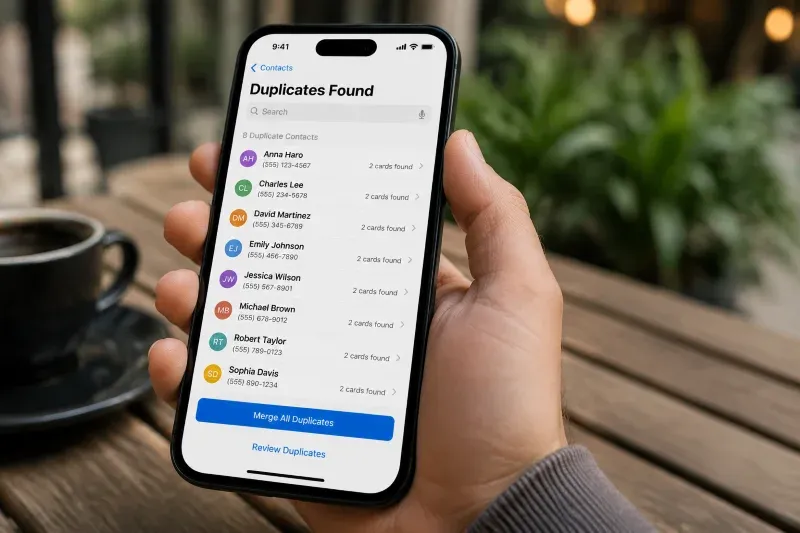
According to Gartner's cross-industry research, poor data quality costs organizations an average of $12.9 million per year, and duplicate records are consistently ranked among the top three causes of that loss. For individuals, the stakes are lower in dollar terms but equally disruptive: a cluttered, duplicated contact list quietly erodes the reliability of every call, message, and automated workflow that depends on it.
Most people don't think of their contact list as a data quality problem. It's just a phone book, right? But the moment you have two entries for the same person, different numbers, inconsistent names, partial details scattered across both your phone, your apps, and your automated systems, you start making decisions based on incomplete information. The results range from mildly annoying (a birthday reminder firing twice) to genuinely costly (a message sent to an old number, a client call that never connects, a calendar invite that disappears into the wrong address).
This article breaks down what duplicate contacts actually are, why they form in the first place, the specific risks they introduce, and the practical steps you can take to prevent them from piling up again.
What Are Duplicate Contacts and Why Do They Keep Appearing?
Duplicate contacts are two or more entries in your address book that represent the same person or entity, often with overlapping or conflicting information. A contact duplicate isn't always an obvious copy-paste error. More often, it's a subtle inconsistency: one entry has a mobile number and email, another has a work number and a slightly different name spelling, and neither is complete on its own.
The Most Common Causes of Duplicate Contacts
Understanding where duplicates come from makes them much easier to prevent. The most frequent sources are:
- Multi-device syncing without consolidation. When you sync contacts across a phone, tablet, laptop, and a cloud account, each platform may interpret and store entries slightly differently. A contact added on one device can arrive on another as a new entry rather than an update to an existing one.
- Importing from multiple sources. Pulling contacts from Gmail, a CRM, LinkedIn, or a work directory into the same address book almost always creates overlaps. Each source formats names, numbers, and emails differently, and most import tools don't cross-reference what's already there.
- Manual entry errors. Typing the same contact twice under slightly different names, "Dr. Smith" and "David Smith," for example, is one of the most common origins of a duplicate phone number in an address book.
- App migrations and phone upgrades. Switching devices or transferring data from a backup frequently multiplies existing entries rather than cleanly replacing them.
- Shared or team contact databases. When multiple people maintain the same contact list, inconsistent entry habits quickly generate a backlog of duplicates.
The result is a contact list that looks full but functions poorly, with conflicting phone numbers and fragmented histories spread across multiple entries for the same person.

Why Duplicate Contacts Are More Damaging Than They Look
Duplicate contacts are rarely an urgent-feeling problem, which is exactly why they're dangerous. The consequences accumulate quietly across communication, productivity, and data integrity until something goes visibly wrong.
Communication Failures Caused by Duplicate Phone Numbers
A duplicate phone number situation creates a specific, high-stakes risk: your device or app may route a message, call, or notification to the wrong entry. If one entry has an outdated mobile number and another has the current one, the autocomplete and recent-contacts features will sometimes surface the wrong one, especially if the outdated entry was used more recently.
Missed calls from important contacts become far more likely when the caller ID can't match an incoming number to the right entry. Instead of seeing a name, you see a number, and you hesitate or decline. For family members, doctors, or time-sensitive professional contacts, that hesitation has real consequences.
Professional Risks: Client Confusion, Lost Leads, and CRM Errors
For anyone who manages business relationships on their phone, duplicate contacts translate directly into professional risk. Sending a follow-up to an old email address, calling a number that was changed two years ago, or leaving a voicemail for a client at a number that now belongs to someone else are all byproducts of a contact list that hasn't been deduplicated.
Inside CRM systems, the damage compounds. Duplicate records split a client's history across two or more entries, so any interaction logged against one record is invisible from the other. Sales reps end up calling the same prospect multiple times because the second contact entry shows no recent activity. Marketing campaigns fire twice to the same person. Analytics metrics inflate because the same individual is counted as two separate leads.
Privacy and Security Risks You May Not Have Considered
A contact duplicate isn't just a nuisance; it can be a privacy liability. When you share your contact list with an app, backup service, or third-party integration, duplicates increase the volume of data being transmitted and stored. More data points, more entries, more potential exposure.
More concretely: if you're sending a sensitive message and your messaging app autocompletes to the wrong entry, an old number now belonging to someone else, that information reaches an unintended recipient. This risk is low in any single instance but compounds significantly in high-volume communication workflows.
The Productivity Tax of Maintaining a Messy Contact List
The time cost of duplicate contacts is real, even if it's invisible. Every time you search for someone and have to choose between two entries, every time you manually check which number is current, every time you clean up a failed message delivery, that's time spent compensating for a problem that shouldn't exist.
Research cited by HubSpot puts the average cost of a single duplicate record at $96 to resolve in enterprise contexts. At the individual level, the cost is measured in minutes rather than dollars, but those minutes accumulate. Combing through a contact list with hundreds of duplicates to find, merge, and correct entries can take hours, hours that repeat every time the list grows unchecked.
How Duplicates Break Automated Systems
Automation is where duplicate contacts cause the most invisible damage. Email campaigns, call routing rules, reminder systems, birthday notifications, and scheduling apps all depend on a single, accurate record per contact. When the same person exists as two entries:
- Email tools send the same message twice, which triggers spam filters and damages sender's reputation.
- Call routing software can't determine which number to prioritize, leading to misdirected or missed calls.
- Analytics platforms count one person as two, inflating engagement metrics and distorting reporting.
- Reminder and scheduling apps fire duplicate notifications, eroding their own usefulness.
The more automation you rely on, the more expensive a messy contact list becomes.
-320x320.webp)
How to Prevent Duplicate Contacts From Building Up Again
Prevention is significantly less work than cleanup. A few consistent habits are enough to keep your contact list clean over the long term.
- Choose one authoritative source and stick to it. Whether that's Google Contacts, iCloud, or another service, designate a single platform as the primary record keeper. All other devices and apps should sync to that source, not independently maintain their own versions. This eliminates the most common cause of duplicates at the root.
- Standardize name and number formatting before saving. Decide on a format, "First Last" vs. "Last, First," country codes included or not, and apply it consistently. Inconsistent formatting is the primary reason imports and syncs create new entries instead of updating existing ones. A contact saved as "+1 555 000 1234" and another saved as "555-000-1234" may be treated as two different records by sync engines.
- Audit your contact list on a regular schedule. Once a month or once a quarter, scan your address book for obvious duplicates and merge them. Apps like Sync.me's contacts manager automate this process by identifying duplicate entries and suggesting merges, which significantly reduces the time involved.
- Be selective about import sources. Every time you import contacts from a new source, you risk introducing duplicates. Before importing, check whether the platform offers a deduplication option, or export only the contacts that aren't already in your list.
- Regularly sync and back up with deduplication enabled. Use a contacts management tool that checks for existing entries before creating new ones. Sync.me's contacts backup feature syncs and backs up your contacts while helping you maintain a clean, consolidated address book rather than accumulating copies across backups.
- Verify before adding. When you receive a new number for someone already in your contacts, update the existing entry rather than creating a new one. This single habit prevents the majority of contact duplicate situations caused by manual entry.
The Real Cost of Ignoring Duplicate Contacts Until It Becomes a Problem
The strongest argument for dealing with duplicate contacts proactively isn't efficiency - it's reliability. A contact list riddled with duplicates is one that you can't fully trust. You can't be confident that a call will reach the right person, that a message will go to the current number, or that your calendar and reminder apps are working from accurate data.
Communication failures, professional missteps, privacy risks, and wasted time are all downstream effects of a problem that starts small and grows without attracting attention. The good news is that prevention requires almost no ongoing effort once the right habits and tools are in place.
Audit your contacts today. Identify the duplicates, merge what can be merged, and set up a single authoritative sync. The few minutes you spend now are worth far more than the calls you'll avoid missing, the messages you'll avoid misdirecting, and the time you'll avoid losing to cleanup later.
Keep your contacts clean, current, and duplicate-free
Stop wasting time and reduce errors by managing duplicate contacts proactively. Download Sync.me to automatically detect duplicates, merge entries, and maintain a clean, accurate address book.
Frequently Asked Questions
How do duplicate contacts affect automated messaging systems?
Automated tools like email campaigns, SMS schedulers, and reminder apps rely on a single record per contact to function correctly. When duplicate contacts exist, the same person often receives the same message twice, which triggers spam filters, inflates engagement metrics, and undermines the reliability of the system over time. In call routing systems, duplicates can cause misdirected or missed calls if conflicting numbers are assigned to the same contact.
Are cloud-based contact syncs more prone to creating duplicates?
Yes, in some situations. Cloud syncing is the most common cause of duplicate contacts because each device or app involved in a sync may create a new entry instead of updating an existing one, particularly when name formatting or number formatting differs between sources. Using a single authoritative cloud account and enabling deduplication checks before syncing significantly reduces this risk.
Can duplicate contacts contribute to spam calls or phishing risks?
Indirectly, yes. A bloated contact list with many duplicate entries increases the surface area of data you share with apps, backup services, and third-party integrations. More redundant data means more information potentially exposed in a breach or misused by an app with broad contact permissions. Keeping your list clean and consolidated reduces that exposure.
Can having duplicate phone numbers lead to missed or misrouted calls?
Yes. A duplicate phone number scenario creates ambiguity for caller ID systems: if two entries share the same number or if an outdated number is still attached to an active entry, your phone may display the wrong name or no name at all. This leads to hesitation or declined calls from contacts you'd otherwise recognize immediately. For time-sensitive calls from doctors, schools, or business contacts, misidentification matters.
What are the long-term productivity losses caused by unmanaged duplicates?
Over time, unmanaged duplicate contacts force you to spend increasing amounts of time on manual verification: checking which number is current, choosing between two entries when composing a message, and correcting failed deliveries. Research cited by HubSpot estimates the average enterprise cost of resolving a single duplicate record at $96. At a personal level, the cost is time, and in a contact list with dozens or hundreds of duplicates, that time adds up to hours per year spent compensating for a problem that preventive habits could eliminate entirely.
مقالات ذات صلة
How to Back Up My Contacts: Easy Ways to Back Up and Restore Contacts
Learn how to back up your contacts, restore them safely, and use cloud or manual methods to protect your phone contact data.
Scam Number Detector: How to Check if a Phone Number Is a Scam
Learn how a scam number detector works and how to check suspicious calls using caller ID tools, scam databases, and lookup services.